
From Legal Support to Fee Earning: A Practical Career Guide
8 to 10 Minutes
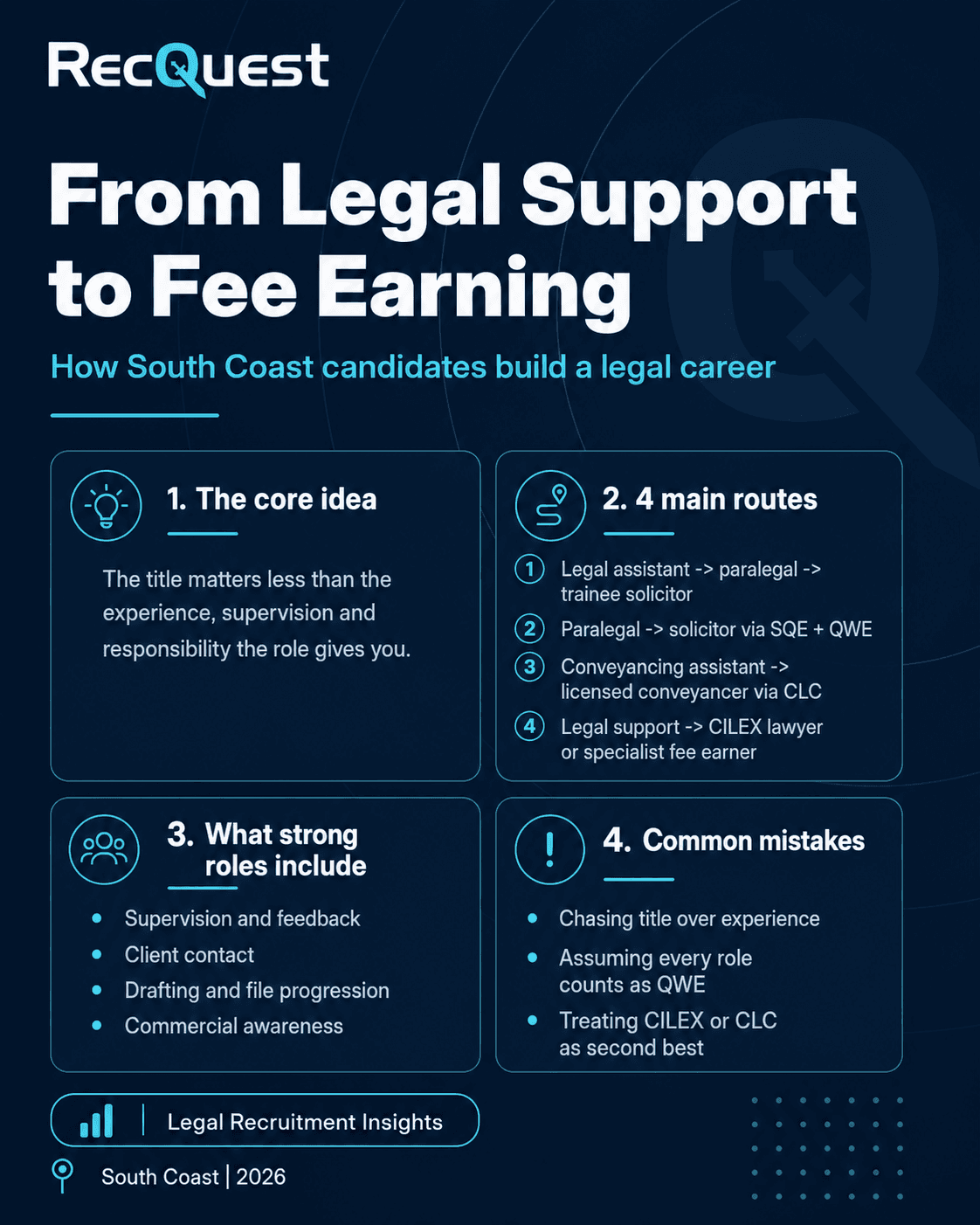
From Legal Support to Fee Earning: A Practical Career Guide
By Ben Holtom, Founder of RecQuest Published 1 June 2026 | Last updated 1 June 2026
If you are working in a legal support role, the route into fee earning work can feel unclear.
Firms use different titles for similar jobs. A "legal assistant" in one practice may draft client letters and progress files. In another, the same title means scanning, filing and diary management. A "paralegal" role may sound more advanced, but some are heavily process based. A conveyancing assistant in a busy residential team may get more practical legal exposure than a paralegal in a larger, more segmented department.
The title on the advert is not the thing that matters most. The work the role actually lets you do is what determines whether it moves your career forward.
At RecQuest, we recruit for law firms across the South Coast, and this is one of the most common career questions we hear: how do I move from legal support into a fee earning role?
This guide covers the main routes, the qualification options, the practice areas where progression happens most naturally, and what to ask at interview so you can assess the opportunity properly.
Key Takeaways
Legal support can be a genuine route into fee earning work, but only if the role gives you real legal exposure.
A better title does not always mean better progression. Assess the work, not the name.
The strongest early career roles include supervision, client contact, drafting, file progression and structured feedback.
SQE/QWE, CILEX and CLC have created more routes into legal qualification than the traditional training contract alone.
South Coast law firms often value practical experience, reliability and local market understanding as much as academic profile.
Why Your Legal Support Role Matters More Than You Think
A support role is often treated as a stepping stone. That is understandable, but the right support role can do more for your career than you might expect.
In regional and high street law firms, especially across Hampshire, Dorset, Surrey and Wiltshire, support roles are where future fee earners are first tested. Firms are watching whether you can handle client communication professionally, follow process without missing detail, keep files moving, manage deadlines, take feedback, and show judgement before being given more responsibility.
That is why the early role matters. It is not just about putting "law firm experience" on your CV. It is about building evidence that you can be trusted with progressively more valuable legal work.
For context on what legal support roles are currently paying across the region, our legal secretary salary guide and paralegal salary guide cover Hampshire, Dorset, Surrey and the wider South of England.
What Changes When You Become a Fee Earner?
A fee earning role means you are contributing directly to the legal service the firm charges for. That brings more opportunity, but also more responsibility.
Area | Legal support role | Developing fee earner | Established fee earner |
|---|---|---|---|
Main focus | Supporting files, clients and lawyers | Progressing legal work under supervision | Managing matters, clients and outcomes |
Client contact | Often administrative or process based | Regular updates and guided advice | Direct advice and relationship ownership |
Drafting | Formatting, preparing or first drafts | Drafting under supervision | Drafting, reviewing and approving |
Billing | Usually no individual target | May record time or contribute to billing | Responsible for fee income |
Progression value | Builds foundation | Builds legal competence | Builds reputation and client trust |
Good firms build this capability in stages. If a role expects you to carry client responsibility without proper training, that is a warning sign, not a compliment.
The Four Main Routes from Support to Fee Earning
The right route depends on your practice area, qualifications, financial situation and long term goals. For a detailed comparison of qualification outcomes, see our guide to legal executive vs solicitor vs licensed conveyancer.
1. Legal Assistant to Paralegal to Trainee Solicitor
This is still one of the most recognised routes. You start as a legal assistant, build department knowledge, move into a paralegal role, and then secure a training contract or solicitor qualification pathway.
This route works well if you have strong academics, want broad solicitor qualification, and are willing to build trust inside a firm before asking for progression.
The challenge is that training opportunities are competitive. A legal assistant role does not guarantee a training contract, so ask sensible questions early. Have they supported staff into training roles before? What would you need to demonstrate to be considered? How often are junior staff reviewed for progression? Is progression based on vacancies, performance or a formal structure?
2. Paralegal to Solicitor Through SQE and QWE
The SQE route has made paralegal experience more strategically important.
The SRA requires candidates qualifying through SQE to complete two years of full time (or equivalent) qualifying work experience. QWE must involve real legal services, can be gained before, during or after SQE assessments, and can be built across up to four organisations. It can include paralegal work, law clinic experience, placements or a training contract, provided the requirements are met.
Not every paralegal role automatically counts as QWE. The important tests are whether the role involves legal services, whether the experience is real rather than simulated, and whether it can be confirmed by a solicitor or COLP.
A strong QWE building role typically includes drafting letters or documents, legal research, client contact, preparing attendance notes, reviewing documents, supporting case preparation, progressing files under supervision, and exposure to client care and professional standards.
A lower paid paralegal role with genuine QWE value may be stronger than a better titled role with limited legal substance. But that only works if the supervision and confirmation position is clear from the start.
3. Conveyancing Assistant to Licensed Conveyancer Through CLC
For candidates in residential property, the route into fee earning work does not always need to be solicitor qualification.
A conveyancing assistant can progress into a property paralegal role, then into a junior fee earning role, and potentially towards becoming a licensed conveyancer through the CLC route. This suits candidates who enjoy residential or commercial property work, are confident with process and deadlines, and want a qualification that aligns directly with what they are already doing.
A conveyancing assistant role is a strong platform if it gives exposure to onboarding, searches, enquiries, mortgage offers, exchange preparation, completion statements, post completion, and client and agent updates.
The risk is that some conveyancing assistant roles are too narrow. If the role is limited to one part of the transaction for too long, progression stalls. The question to ask is: will this role help me understand the whole transaction, or only one small part of it?
If you are already working in property, our conveyancing assistant jobs page shows what is currently available across the South Coast.
4. Legal Support to CILEX Lawyer
CILEX is a strong route for candidates who want to qualify while working and build specialism in a particular area. It is especially relevant for candidates in private client, family, employment, litigation and conveyancing.
The advantage is that CILEX can align well with people who are already working in law, allowing you to build qualification around practical experience rather than stepping away to study full time.
However, firm support varies. Some firms actively understand and support CILEX progression. Others are positive in theory but vague in practice. Do not rely on goodwill alone. Ask what support exists, whether anyone has qualified through the route before, and how responsibilities increase as studies progress.
For more on how private client careers develop through CILEX and other routes, see our private client career path guide.
Which Qualification Route Fits Your Career?
Qualification routes are often explained from the perspective of regulators or course providers. Most candidates need a simpler question answered: which route fits the work I am already doing, and the career I actually want?
SQE/QWE is usually the best fit if your long term aim is to qualify as a solicitor. It is most useful for paralegals and legal assistants who are already doing real legal work. The route is flexible because QWE can be gained across different organisations and before, during or after SQE assessments. The watch point: SQE is flexible, but not automatically easy. You still need the right work, the right supervision, and the resilience to manage study and exams alongside a demanding role.
CILEX is usually the best fit if you want to become a specialist legal professional while working in practice. It suits candidates who know their practice area and want qualification to reflect that specialism. The watch point: CILEX still needs commitment, structure and employer support. Understand the time, cost and study expectations before starting.
CLC is usually the best fit if you want to specialise in conveyancing. For a conveyancing assistant, this is a practical and commercially sensible route that aligns directly with the work being done. The watch point: a property specialism is valuable, but it is narrower than solicitor qualification. That is not a problem if you want a property career, but it matters if you want wider practice area flexibility later.
Internal progression without immediate qualification is also a route. Some South Coast firms develop strong legal assistants and paralegals into junior fee earning roles because they have proven themselves internally. This can work, but it has a ceiling if qualification is never addressed. Understand whether internal progression is a short term step, a long term route, or a bridge into SQE, CILEX or CLC.
Practice Areas Where Support Leads to Fee Earning
Some practice areas lend themselves particularly well to progression from legal support into fee earning work.
Residential conveyancing offers one of the clearest routes because the process is structured and repeatable. A conveyancing assistant can learn the transaction lifecycle, build confidence with clients and agents, and progress towards handling parts of files under supervision. The opportunity is strong, but the pressure is real. Residential conveyancing is fast paced, deadline heavy and emotionally demanding for clients. For salary context, see our commercial property solicitor salary guide, which includes comparisons with residential roles.
Private client support roles can develop into strong fee earning careers if you build technical understanding around wills, probate, lasting powers of attorney, trusts and estate administration. Progression is often slower than conveyancing, but the work can be rewarding for candidates who enjoy detail, empathy and long term client relationships. Our private client solicitor salary guide covers what qualified practitioners earn across Hampshire and Dorset.
Family law support roles expose you to client care, court documents, disclosure, statements and sensitive communication. It can be an excellent development area, but it requires emotional resilience and careful supervision.
Litigation support develops drafting, document review, chronology building and procedural awareness. It suits candidates who enjoy structure, argument and detail.
Employment support roles involve tribunal preparation, document bundles, client contact, settlement agreements and policy work. This can be a strong route for candidates who like a mix of people issues, drafting and commercial context.
How to Tell If Your Current Role Can Progress
A role is more likely to lead towards fee earning if it gives you responsibility in stages.
Good signs: You sit close to fee earners and hear how decisions are made. Your work is reviewed and feedback is given. You draft documents, even simple ones. You speak to clients, agents or third parties. You understand what happens before and after your task. You are trusted with deadlines. Your manager can describe a progression route. The firm has previously promoted support staff. Your role gives exposure to compliance and client care.
Warning signs: You only do scanning, filing or document uploads. No one reviews your work properly. The firm uses "progression" vaguely but gives no examples. You never speak to clients or external parties. You only touch one narrow process. There is no discussion about qualification routes. You are given a better title but no better experience.
The strongest roles are not always the easiest. But they should be structured, supervised and developmental.
How to Position Your Experience When Applying
When applying for your next step, do not just list tasks. Show progression.
Instead of writing: file opening, client contact, drafting letters, diary management
Frame it as: Supported fee earners across live residential property matters. Prepared first draft client correspondence for review. Liaised with clients, estate agents and third parties to progress matters. Managed key dates, file updates and compliance steps. Developed practical understanding of the conveyancing process from instruction to post completion.
The second version makes the career direction clearer. It shows you are building towards responsibility, not just completing tasks.
If you want to practise your interview skills before applying, RecQuest Ready is a free training tool designed for legal graduates and early career candidates preparing for their next step.
How to Discuss Progression at Interview
Candidates often avoid asking about progression because they do not want to sound impatient. That is understandable, but avoiding the subject completely is a mistake.
Useful questions that show you are serious without sounding entitled:
What does success look like in this role after six months?
Have people moved from this role into paralegal, trainee or fee earning positions before?
How is work supervised and reviewed?
Would the role provide exposure to drafting, client contact or file progression?
Does the firm support SQE/QWE, CILEX or CLC routes?
How does the department decide when someone is ready for more responsibility?
What South Coast Firms Usually Look For
South Coast law firms are not all the same. A larger regional firm in Southampton operates differently from a high street firm in Dorset, a boutique private client practice in Winchester, or a growing property department in Portsmouth.
But in our day to day work with firms and candidates, the same themes appear repeatedly. Firms are looking for people who communicate clearly with clients, work accurately without constant chasing, manage competing deadlines, show commitment to the practice area, build trust with senior lawyers, stay calm under pressure, and understand that law firms are commercial businesses as well as professional practices.
For early career candidates, technical knowledge is only part of the picture. A candidate who can say "I understand the process, I know where I need supervision, and I am ready to take on more responsibility carefully" will often come across better than someone who simply says "I want progression."
For a broader view of working with a specialist recruiter on the South Coast, see our guide on why legal professionals use a specialist legal recruiter.
Benchmark Your Salary Before You Move
Before making a career move, understand what your experience is worth in the current market. The LawBoard salary estimator provides free salary benchmarks for legal professionals across England and Wales, filtered by practice area, PQE, region and firm size.
If you want more local detail, our salary guides cover specific roles across the South Coast:
Frequently Asked Questions
Can a legal assistant become a fee earner without a law degree?
Yes. SQE/QWE, CILEX and CLC routes all offer paths into fee earning work that do not require a traditional law degree. What matters is practical legal experience, the right supervision, and a qualification route that fits your career goals.
How long does it take to move from legal support to fee earning?
It depends on the route. A conveyancing assistant in a well structured team may progress into junior fee earning work within 12 to 24 months. SQE qualification requires at least two years of qualifying work experience. CILEX and CLC timelines vary depending on study pace and employer support. Internal progression without formal qualification can happen faster but may have a ceiling.
Does every paralegal role count as qualifying work experience?
No. The SRA says QWE must involve real legal services and exposure to solicitor competences, confirmed by a solicitor or COLP. Roles that are mainly administrative are unlikely to qualify. Ask explicitly before accepting a role on the assumption it will count.
Is CILEX or CLC considered less credible than becoming a solicitor?
That is outdated thinking. For the right candidate, CILEX or CLC can be a focused, practical and respected route into specialist legal work. The issue is not whether the route is "better" or "worse" than solicitor qualification. The issue is whether it fits your career goals and practice area.
How can RecQuest help?
RecQuest works with legal professionals across the South Coast who are working through exactly this kind of career move. If you are weighing up your next step, get in touch or browse current roles to see what is available across Hampshire, Dorset, Surrey, West Sussex and Wiltshire.
This article was written by Ben Holtom, Founder of RecQuest, a specialist legal recruitment consultancy based in Romsey, Hampshire. RecQuest places solicitors, legal executives, paralegals and legal support staff into law firms across Hampshire, Dorset, Surrey, West Sussex and Wiltshire.